English
 中文
中文 Pусский
 Español
 Français
 عربي
عربي
How to Choose the Right UV Curing Machine for Screen Printing
A UV curing unit that performs perfectly on a stop-cylinder press printing paper sheets may deliver incomplete curing on a high-speed rotary line running on plastic substrates. The mismatch is rarely about build quality—it's about specification fit. Curing is a photochemical process, and the machine that drives it must be matched to the ink chemistry, substrate heat sensitivity, and production throughput. Five specifications determine whether a UV dryer integrates smoothly into a screen printing line or becomes a daily source of rejected sheets and slowed cycle times.
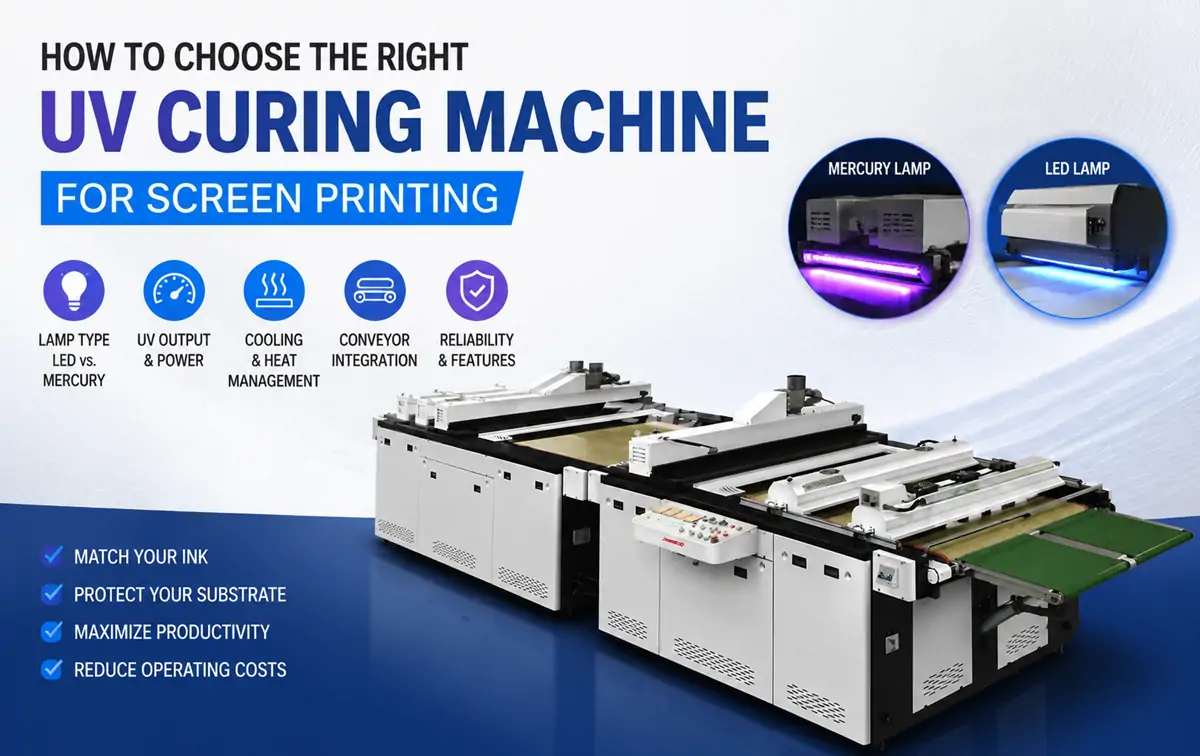
1. Lamp Type: Mercury Vapour vs. LED
The choice between traditional mercury vapour lamps and LED arrays is the first branching point in selecting a curing unit, and it carries consequences for operating cost, substrate compatibility, and print quality. The table below summarises the key differences that matter most in daily production.
| Comparison Dimension | Mercury Vapour Lamp | LED Array |
|---|---|---|
| Spectrum | Broad (UVA/UVB/UVC/visible), peaks around 365 nm | Narrow, single wavelength (365/385/395/405 nm) |
| IR Heat on Substrate | High, lamp surface reaches 600–800°C | Negligible; substrate typically stays below 40°C |
| Lamp Lifespan | 1,000–2,000 hours | 20,000+ hours |
| Startup Time | Requires warm-up, cannot be switched frequently | Instant on/off |
| Energy Consumption | Higher | 50%–70% less than equivalent mercury system |
| Ink Compatibility | Wide, works with most UV screen printing inks | Requires LED-specific photoinitiator formulations |
| Ideal Substrates | Paper, board, heat-tolerant materials | Thin films, heat-sensitive plastics, dimensionally unstable materials |
Mercury vapour lamps emit a broad spectrum across UVA, UVB, UVC, and visible light. This broad spectrum cures a wide range of UV screen printing inks without reformulation. However, the substantial infrared radiation makes them unsuitable for heat-sensitive substrates unless the machine includes robust cooling. Lamp life typically runs 1,000 to 2,000 hours before output degrades below usable levels, and the lamps contain mercury, requiring proper disposal procedures.
LED curing units emit a narrow spectrum and produce negligible infrared heat, making them the preferred choice for thin films, heat-sensitive plastics, and applications where dimensional stability matters. LED arrays last 20,000 hours or more, switch on and off instantly without warm-up, and consume roughly 50% to 70% less energy than an equivalent mercury system. The limitation is ink compatibility—many UV screen printing inks were formulated for broad-spectrum mercury output and will not cure fully under a narrow LED wavelength without reformulation.
For shops printing a wide variety of inks and substrates, a well-designed UV Curing Machine with mercury lamp technology offers maximum ink compatibility. For shops running dedicated LED-compatible inks and heat-sensitive materials, the operational savings of LED often justify the switch.
2. Lamp Power, UV Output, and the Wattage Trap
Relying solely on lamp wattage to compare curing units is a common mistake. Wattage measures electrical power input, not UV output. Two 8 kW lamps from different manufacturers can deliver different UV energy at the substrate surface due to reflector design, lamp ageing, and distance from the substrate.
The two specifications that matter are:
• Peak irradiance (W/cm²): Determines whether the ink receives enough UV intensity to trigger the photoinitiator reaction through the full ink film thickness.
• Energy density (mJ/cm²): The total UV energy accumulated as the sheet passes under the lamp—a function of irradiance multiplied by dwell time.
Ask for a UV output profile chart that shows irradiance across the lamp width at a specified distance. A lamp that delivers 800 mW/cm² at the centre but drops to 500 mW/cm² at the edges will cure unevenly on full-width sheets. The ratio of minimum to maximum irradiance across the curing width should be 0.85 or higher for consistent results.
3. Lamp Spectrum and Ink Matching
UV ink photoinitiators are designed to absorb specific wavelength ranges. A mercury lamp's broad output covers multiple photoinitiator absorption peaks simultaneously, which is why it works with so many ink formulations. LED systems target a single narrow wavelength, and the photoinitiator must be tuned to that specific peak.
Some specialised inks—such as those for glass, metal, or heavy deposits—require the short-wavelength UVC output (around 254 nm) that only mercury lamps provide. Before committing to a lamp type, test the specific ink and substrate combination with a radiometer that measures the specific wavelength band of interest—not just total UV.
4. Cooling Method and Heat Management
The infrared heat generated by mercury lamps must be removed before it warps the substrate or destabilises the registration. Three cooling approaches exist:
• Air cooling uses exhaust fans to draw ambient air across the lamp and substrate. It works well for paper and board stocks above 200 gsm but can stir up dust and is less effective for thick ink deposits requiring longer dwell times.
• Water cooling circulates chilled water through the lamp housing and reflector. The lamp envelope runs cooler, extending lamp life, and less infrared reaches the substrate. Water-cooled systems are quieter and cleaner, ideal for electronics printing and other dust-sensitive environments, but they add plumbing complexity and cost.
• Dichroic reflectors reflect UV while transmitting a portion of the infrared through the back of the reflector. Used in both air- and water-cooled systems, they reduce substrate heating without additional energy consumption and are worth specifying for any mercury lamp system running heat-sensitive materials.
5. Conveyor and Sheet Handling Integration
A UV curing unit is rarely a standalone purchase. It integrates directly with the screen printing press, matching the sheet size, speed, and delivery method.
Belt width must accommodate the maximum sheet size printed on the upstream press. Speed range must match or slightly exceed the press's maximum output—a curing unit running at 100 m/min behind a press printing at 120 m/min creates a bottleneck. If the press runs at variable speeds for different jobs, the dryer must track that speed dynamically.
Belt surface material also matters. A non-slip silicone belt holds small or lightweight sheets in place through the curing zone. For heavy board stocks, a flat mesh belt allows air circulation and prevents heat buildup on the underside. Some machines offer vacuum belt options that hold sheets by suction, eliminating mechanical guides in the curing zone and reducing the risk of marking freshly printed surfaces.
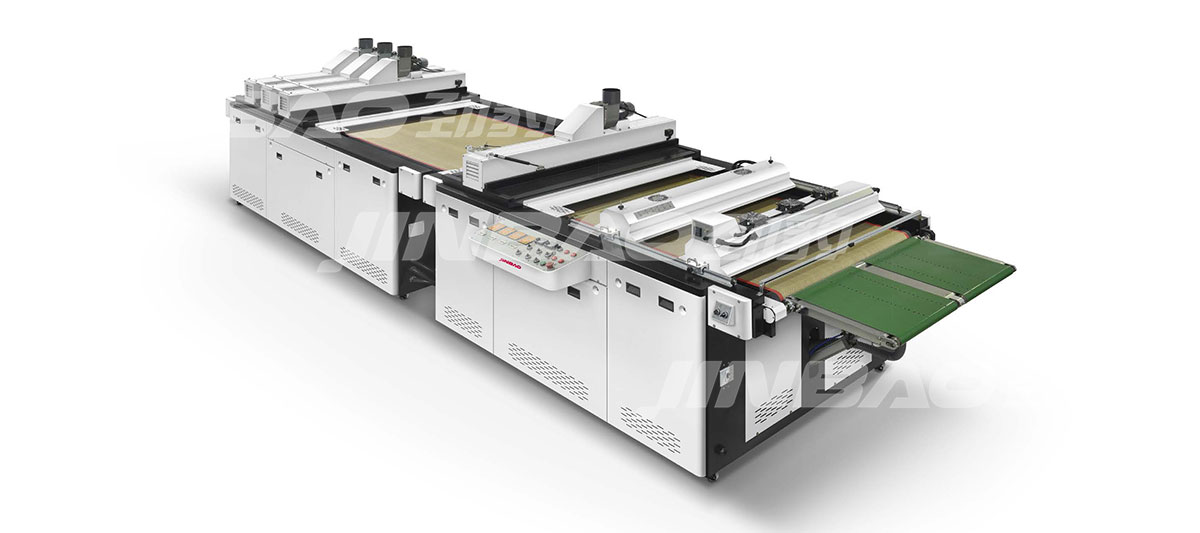
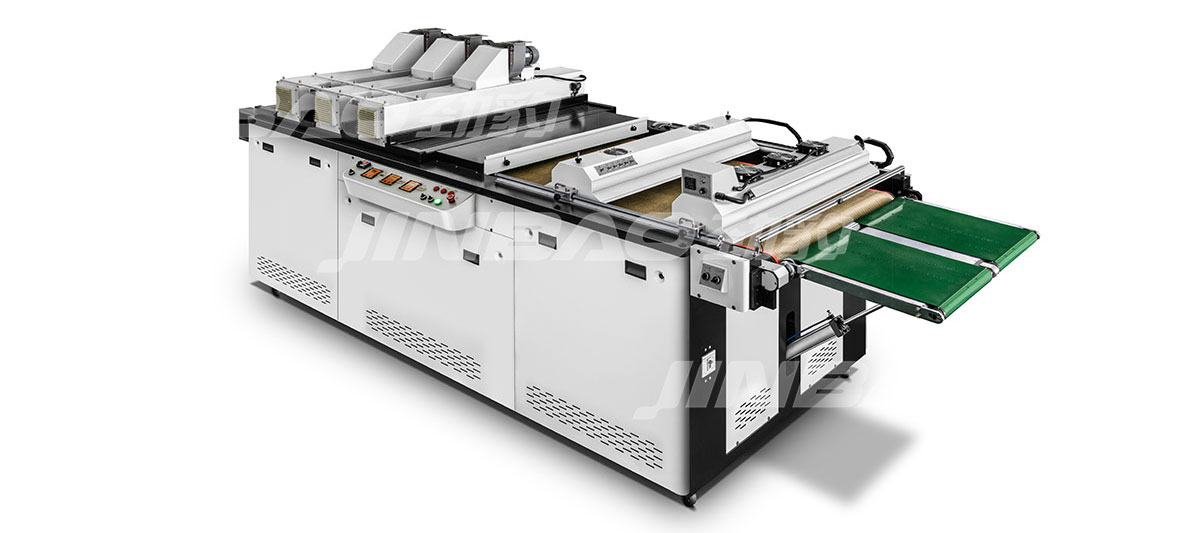
For shops evaluating curing systems that integrate with both automatic and semi-automatic presses, reviewing detailed specifications for in-line UV drying equipment can help confirm that the conveyor speed range, belt width, and cooling method align with the upstream press and the substrates being processed.
6. Auxiliary Features Worth Specifying
Several features that do not appear on a basic spec sheet affect daily productivity. A shutter system that closes automatically when the conveyor stops prevents scorching of stopped sheets under a mercury lamp. Variable lamp power control, rather than simple on/off switching, allows the operator to reduce output for slow runs or thin ink deposits without changing lamps. An integrating radiometer, built into the lamp housing, provides continuous UV output monitoring and alerts the operator when output drops below a preset threshold—indicating lamp ageing before it affects product quality.
Choosing Based on Your Production Reality
The right curing unit is the one matched to your ink system, your most demanding substrate, and the maximum speed you run regularly. A shop printing standard UV inks on paper at moderate speed will be well served by an air-cooled mercury system. A shop printing LED-formulated inks on thin films at high throughput will benefit from an LED array with instant on/off. The specification that confirms the match is not wattage, but the measured irradiance at the ink's photoinitiator wavelength, verified with a radiometer at production speed.
For those comparing curing solutions across different configurations, JINBAO's range of screen printing UV curing equipment includes options for both mercury lamp and LED technologies, with air- and water-cooled models matched to automatic and semi-automatic press lines. Requesting detailed technical documentation can help verify that the lamp type, cooling method, and conveyor specifications fit your specific ink and production requirements.