English
 中文
 Pусский
 Español
 Français
 عربي

Cylinder Screen Printing Machine Guide: Technology, Types and Selection
A cylinder screen printing machine is a sheet-fed press in which the substrate is carried on a rotating cylinder while a flat screen and squeegee transfer ink onto it. Because the sheet is mechanically held rather than merely laid on a table, cylinder presses are widely used for multi-colour overprinting, heavy ink deposits and paperboard packaging. This guide explains how the mechanism works, the main design types, the specifications that decide output and quality, and the checks a buyer should complete before comparing quotations.
The article is written for production managers and equipment buyers who already understand the basics of screen printing and need to judge whether a cylinder design fits their job mix, or whether a flatbed or semi-automatic press would serve them better.
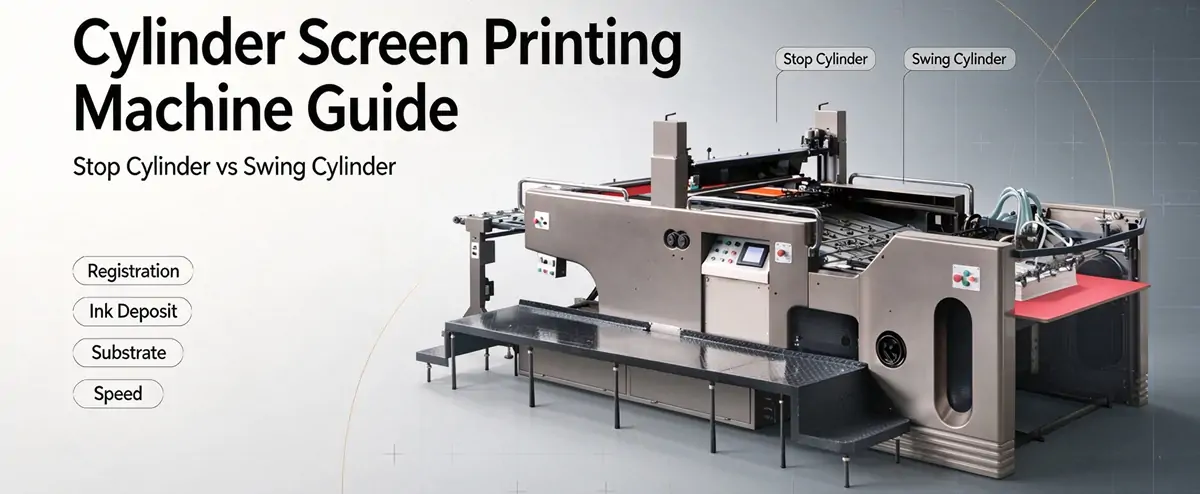
What Is a Cylinder Screen Printing Machine?
A cylinder screen printing machine holds each sheet by grippers against a rotating cylinder and passes it beneath a flat screen. The squeegee travels across the screen while the sheet is held in a fixed position relative to the stencil, forcing ink through the open mesh onto the substrate. After the print stroke, the cylinder advances and the sheet is released to the take-off and drying section.
The cylinder is a transport and positioning component, not the stencil itself. In sheet-fed cylinder presses, the screen stays flat above the cylinder; the cylinder's contribution is that it keeps the sheet under mechanical control through the entire ink transfer step. That control is what separates a cylinder press from a flatbed press, where the sheet sits on a flat table and registration depends on how accurately it was placed and how firmly it is held during the squeegee pass.
Where the cylinder design fits:
- Flexible and semi-rigid sheet substrates that can be carried around a cylinder without cracking
- Multi-colour work where each colour must land on the previous one within a consistent tolerance
- Heavy ink deposits such as opaque white, metallic effects, spot UV and cold foil adhesives
- Folding carton, label, decal and transfer work produced in sustained volumes
Where it does not fit:
- Very thick or rigid boards that cannot be wrapped or held on a cylinder
- Three-dimensional objects such as moulded parts, bottles or assembled components
- Very short runs where the setup time of an automatic press outweighs the speed advantage
- Single-colour work on inexpensive substrates where a flatbed or semi-automatic press is adequate
Jinbao Machinery has manufactured automatic screen printing machines and auxiliary equipment since 1997, and its cylinder range covers several formats and drive configurations rather than a single model. The company's products are applied in graphics printing, print finishing, garment transfers and textile printing, and its production compound covers 5.32 hectares with 147 employees, including 41 technicians with a college education or higher.
How a Cylinder Screen Printing Machine Works
The press is a sequence of six mechanisms that must be timed to each other. A weakness in any one of them limits the performance of the whole line, which is why specification comparisons should look at the system rather than at a single headline speed figure.
1. Sheet Feeding and Pile Control
Sheets are stacked on a pile board and separated one at a time by a suction or friction feeder. On a typical cylinder press in this class, the maximum pile height is around 700 mm, which determines how long the press can run unattended before reloading. The feeder must be set for the sheet weight and surface: coated stock, recycled board and thin decal paper all behave differently at the separation point.
Two feeder details matter more than buyers expect. The first is double-sheet detection, because two sheets entering together produce a misregistered print or a jam that costs several minutes of production. The second is pile height consistency, because as the pile drops the angle at which the suction nozzle meets the top sheet changes, and feeding reliability drifts with it.
2. Gripper Transfer and Vacuum Holding
Once separated, the sheet is taken by grippers and transferred onto the cylinder. On Jinbao's stop cylinder presses, the transfer system uses adjustable vacuum antiskid absorption applied to the non-printing side of the sheet. Two benefits follow: the sheet is held flat against the cylinder rather than relying on mechanical grip alone, and the printed surface is never contacted, which reduces rubbed and scratched sheets when the ink film is still soft.
This stage is where most marking problems originate. If the vacuum is set too low, the sheet lifts or slips and registration drifts. If it is set too high on a light stock, the sheet can deform. The correct setting is substrate-specific and belongs in the job record alongside speed, squeegee pressure and ink viscosity.
3. Registration at Front and Side Lays
Registration is the defining capability of a cylinder press. As the sheet arrives at the front and side lays, a self-setting CNC sensor registration system detects its position. If a sheet is misplaced beyond the accepted window, the press stops printing rather than producing a reject that will only be discovered downstream. This automatic intervention is the practical difference between a press that protects overprint accuracy and one that depends on an operator watching every sheet.
Registration performance in production is not a single number taken from a brochure. It depends on the condition of the grippers, the cleanliness of the cylinder surface, the stability of the vacuum, the flatness of the sheet, and whether the screen frame is seated identically after each changeover. Buyers should ask for a demonstration on their own substrate and inspect a multi-colour test sheet across the full run, not only at the start.
4. Flood, Squeegee and Ink Deposit
The flood bar first coats the open mesh with ink, then the squeegee travels across the screen and drives ink onto the sheet. On Jinbao's cylinder presses, the squeegee system uses a pneumatic pressure-keeping device, which maintains constant printing pressure through the stroke. Consistent pressure means a more uniform ink layer and a cleaner printed edge, particularly on large solid areas where pressure loss across the stroke would otherwise show as a density gradient.
Ink deposit is set by four variables that interact: mesh count and thread diameter, emulsion thickness, squeegee hardness and angle, and squeegee speed. A press that can hold pressure constant removes one of those variables from the operator's list of things to chase, which shortens setup and makes repeat jobs more predictable.
5. Cylinder Motion: Dwell or Continuous
This is the step that defines the machine type. In a stop cylinder press, the cylinder halts with the sheet stationary beneath the screen for the duration of the squeegee stroke, then indexes forward. In a swing cylinder press the cylinder keeps moving through the print zone and returns to collect the next sheet, so sheets are fed without a full stop.
The consequence is a straightforward trade: stopping the sheet gives the most stable possible ink transfer position, while continuous motion removes the dwell time and raises output. Everything else in the comparison follows from that single design decision.
6. Take-Off, Curing and Stacking
After printing, the sheet leaves the cylinder and is transferred to the drying or curing section without touching the wet image. UV curing units cure UV inks through photopolymerisation with minimal heat rise, which suits heat-sensitive stock; hot-air dryers evaporate solvents from solvent-based or water-based inks and require a longer tunnel and more careful temperature control. At the end of the line, a stacker piles the sheets without marking them, and the pile must be consistent enough for downstream die-cutting or folding.
The press is therefore only one component of a production line. A press rated at a given output will not reach it if the curing section cannot keep pace, if the stacker cannot accept the sheet size, or if the feeder cannot handle the lightest stock in the job mix. Buyers planning a new line should size the curing and stacking equipment against the press from the outset rather than treating them as accessories.
Main Types of Cylinder Screen Printing Machines
Stop Cylinder Press
In a stop cylinder machine, the sheet pauses under the screen while the squeegee passes. Jinbao's JB-1050A, for example, uses what the company describes as the classic stop cylinder technology, with a maximum speed of 4,000 pcs/h and a printing area of 1050 × 750 mm. The format and the stop motion together make it suitable for ceramic and glass applique, advertising, packaging and printing, brand work, textile transfer and electronics screen printing.
Typical strengths:
- Most stable sheet position during ink transfer, which supports multi-colour overprinting
- Better behaviour on heavy substrates and on jobs with a thick ink film
- Well suited to packaging board, decals and high-value branded work
- Slower than a continuous-motion design by nature, because the dwell time is part of the cycle
Swing Cylinder Press
In a swing cylinder machine, the cylinder moves continuously through the print zone. Sheets can be fed at a higher rate because the press does not wait for a stationary dwell, and the mechanism carries fewer reversal loads than a stop-and-go design.
Typical strengths:
- Higher throughput on compatible substrates
- Well matched to long runs of single-colour or less registration-critical work
- Commonly used for decal and transfer production where tolerances are wider
- Registration window is wider than a stop cylinder design, so it is less suitable for tight multi-colour work
Format and Configuration Variants
Cylinder presses are not limited to one size or one drive. Within the same printing principle, manufacturers offer different maximum sheet formats, different automation levels and different drive systems. Jinbao's range, for instance, includes the JB-1050A and JB-1050AG stop cylinder presses, the JB-106C and JB-145C servo-driven stop cylinder models, the JB-54C/78C/92C series, a CP1 cylinder press configured for decal printing, a JB-720AQ line for electrical and electronic production, and the JB-720/780/1020 full-auto cylinder press series. The right variant depends on sheet size, substrate range and the finishing processes that follow.
Stop cylinder vs swing cylinder at a glance:
| Consideration | Stop Cylinder | Swing Cylinder |
|---|---|---|
| Sheet position during printing | Stationary | Moving with the cylinder |
| Registration behaviour | Most stable, suited to multi-colour overprinting | Wider tolerance, less suited to tight colour work |
| Output characteristic | Moderate, limited by dwell time | Higher on compatible substrates |
| Substrate behaviour | Handles heavy board and thick ink films well | Best on lighter, more uniform stock |
| Typical work | Packaging, decals, branded multi-colour jobs | Long runs, single-colour and transfer work |
| Relative investment | Generally higher for a comparable format | Generally lower for a comparable format |
Stop Cylinder or Swing Cylinder: How to Decide
The decision is not about which design is newer or more expensive. It is about which constraint binds your production. Work through the following questions in order, and the answer usually becomes obvious before the third question.
- Does your work require tight multi-colour registration? If yes, the stop cylinder design is the safer starting point, because the sheet does not move while ink is transferred.
- Is your job mix dominated by one or two colours on uniform stock? If yes, a swing cylinder press can deliver more sheets per shift for a lower investment.
- Does your substrate include heavy board or a thick ink film? If yes, favour the stop cylinder design; the stationary sheet is less likely to shift under a heavy squeegee load.
- Is your bottleneck labour or machine time? If labour is the constraint and volumes are high, the extra output of a swing cylinder press translates directly into cost per thousand sheets.
- Will your job mix change within three years? If you expect to add multi-colour packaging work, buying for the future argues for the stop cylinder design even if today's orders are simple.
Why the Cylinder Design Suits Sheet-Fed Packaging Work
Packaging buyers ask for three things that a cylinder press is built to deliver: consistent overprint across a long run, a heavy and opaque ink layer, and a sheet that reaches the die-cutter without marking.
Overprint consistency. Because the sheet is mechanically held and sensor-checked at the lays, colour-to-colour variation stays inside a controlled window for the length of the run. On a flatbed press the same job depends more heavily on how each sheet was placed, which is why flatbed work tends to be re-checked more often.
Heavy ink deposit. Opaque white, metallic imitations, spot UV varnish and cold foil adhesives are all thick-film applications. The screen carries a large wet ink volume, and the press must hold squeegee pressure constant to lay it down evenly. A pressure-keeping squeegee system is therefore not a comfort feature; it is what makes a large solid area printable without streaks.
Handling without marking. Vacuum holding applied to the non-printing side, plus a take-off that does not drag across the image, keeps the wet print intact. The practical benefit is visible at the stacker: fewer rejects caused by scuffing, and a pile that can go straight into finishing.
For reference, the JB-1050A accepts paper from 90 to 420 g/m² and prints at 800 to 4,000 pcs/h, which spans light graphic stock through folding carton board. Exact capability varies by model and configuration, and buyers should confirm the range for the specific machine under consideration rather than assuming the class average.
Substrates and Applications
Paper and Paperboard
This is the core of cylinder press work: cigarette boxes, wine boxes, cosmetic boxes, gift boxes, trademark printing and special anti-counterfeiting materials. Board in the 200 to 420 g/m² band is typical, and the press must feed it without cracking the score lines and register it without bowing.
Decals and Transfers
Ceramic and glass decals are printed on thin transfer paper, and textile transfers are printed on coated carrier sheets. Both are light stocks that can be fed quickly, but both are unforgiving on registration because the decal is viewed as a finished decoration on a curved surface, where a small offset becomes visible. A CP1 cylinder press configured for decal printing is a common choice for this segment.
Labels and Stickers
Self-adhesive stock adds two complications: the adhesive can stick to feed plates, and the release liner must not delaminate during transfer. Automatic cylinder presses with correctly set vacuum and a clean transfer path manage both, which is why label work is frequently run on this type of press when a thick, opaque ink layer is required.
Plastics, Electronics and Industrial Parts
Membrane switches, conductive patterns, thick-film circuits and appliance panels are screen printed because the process deposits a functional ink layer rather than a thin image. These jobs demand registration accuracy and a consistent deposit thickness, and they often require a clean environment. The JB-720AQ line is configured specifically for electrical and electronic production, which reflects how different the handling requirements are from packaging work.
Key Specifications Buyers Should Compare
Headline speed is the least useful single number in a specification sheet. Compare the following items as a set, and ask for each of them on the model you are actually being quoted.
- Maximum printing area – the largest image the press can produce, which is usually slightly smaller than the maximum sheet size.
- Screen frame size – determines the largest stencil you can stretch and therefore the image size and the screen-making equipment you need.
- Maximum pile height – affects how long the press runs unattended and how often the operator must reload.
- Substrate weight range – the lightest and heaviest stock the feeder and transfer system handle reliably.
- Speed range – the usable band, not the peak figure, and the conditions under which the top of the band is achievable.
- Registration system – whether registration is sensor-checked with automatic stop, and how the system behaves on your substrate.
- Drive system – servo or mechanical, which affects changeover time, motion profile and maintenance profile.
- Power, air and footprint – the utilities and floor space the installation actually requires, including the curing and stacking sections.
Reference specifications, JB-1050A stop cylinder press:
| Parameter | Specification |
|---|---|
| Maximum printing area | 1050 × 750 mm |
| Screen frame size | 1300 × 1170 mm |
| Maximum pile height | 700 mm |
| Paper weight | 90 – 420 g/m² |
| Printing speed | 800 – 4,000 pcs/h |
| Power supply | 3-phase 380 V, 50 Hz, 12.6 kW |
| Total weight | 5,600 kg |
| Overall dimensions | 4.08 × 3.02 × 1.75 m |
These figures describe one model in one configuration. A larger format or a servo-driven version will differ, and the figures should be confirmed against the specific quotation. The JB-1050A stop cylinder press page lists the full parameter table and the mechanical features behind these numbers.
Drive Systems and Automation Level
Two presses with the same format and the same printing mechanism can still differ substantially in how they behave day to day, because the drive system and the automation scope are separate decisions.
Servo drive. Electronically controlled motors allow programmable motion profiles, so the press can be tuned for paper, board or film without changing cams. Acceleration and deceleration can be optimised for the substrate, registration can be held at higher speeds, and job settings can be stored and recalled. Mechanical wear points are fewer than in a cam-driven machine, and changeover is typically faster because settings are entered rather than adjusted by hand.
Mechanical drive. Cam-driven linkages offer a proven, robust motion profile and a lower initial cost. The profile is fixed, so the press behaves the same regardless of substrate, and changeover takes longer because adjustments are physical. For long runs of standard work with a stable specification, this remains a cost-effective choice.
Automation scope. Feeding, registration, printing, take-off and stacking can each be automatic or manual, and a press that automates printing but not feeding is a different proposition from a fully automatic line. The right level depends on labour cost and availability in your region, on run lengths, and on how much variation your job mix contains. A press that is fully automatic but frequently stopped for changeover can be less productive than a simpler machine running the same orders.
Because the press rarely runs alone, the specification should be read together with the equipment around it: UV curing, hot air drying, stacking and screen making. Jinbao builds these as a matched range so that a line can be configured around the press rather than assembled from unrelated parts; the printing line and process configurations page shows how the combinations are applied to cold foil, spot UV and decal work.
How to Choose a Cylinder Screen Printing Machine
Work through the sequence below before requesting quotations. Suppliers can only recommend accurately when the requirement is already defined, and a well-prepared brief usually shortens the commercial discussion by weeks.
- Define the product. Packaging box, decal, label, transfer, membrane switch or graphic print. The product decides the ink system, the deposit thickness and the finishing that follows.
- Define the substrate. Material type and weight range, from the lightest stock you run to the heaviest. A press bought for paper and then asked to run 400 g/m² board will not perform as expected.
- Define the sheet size. Record the largest and smallest sheets in your current mix, then add the sizes you expect to quote in the next two to three years.
- Define the registration requirement. Count the colours, identify which jobs are register-critical, and decide whether automatic sensor checking with stop-on-misplacement is required.
- Choose the printing mechanism. Stop cylinder for accuracy and heavy ink; swing cylinder for throughput on simpler work. Confirm the choice against real job samples rather than impressions.
- Choose the drive system. Servo if your job mix varies and changeover time matters; mechanical if runs are long and specifications are stable.
- Set the automation level. Decide which steps must be automatic, based on labour cost, run length and the acceptable changeover time.
- Size the line, not just the press. Match curing capacity, stacker format and screen-making equipment to the press output, and check the total footprint and utility demand against the building.
Pre-quotation checklist:
- Maximum and minimum sheet size in millimetres
- Substrate types and weight range in g/m²
- Number of colours and the tightest registration requirement
- Typical and peak output per shift
- Ink system: UV, solvent or water-based
- Required ink deposit: standard, heavy or spot UV
- Curing method and available floor space for the line
- Power supply, compressed air capacity and air quality
- Number of changeovers per week and average run length
- Operator skill level and planned training time
Installation, Training and Service Considerations
Service terms explain as much about a supplier as the machine specification, because a cylinder press is a long-term production asset that will need parts, adjustments and occasional diagnosis.
Jinbao's published terms are specific enough to plan around. Before the order, the company can run proofing on the customer's own products to confirm that the equipment meets the printing requirement, and customers can visit the factory to inspect the equipment. Before delivery, a machine installation layout drawing is provided so the site, power supply and air supply can be prepared in advance. After the fully automatic machine arrives, engineers provide one week of free installation training at the customer's site, with the customer covering round-trip airfare and local accommodation.
The warranty period is 14 months from the date of leaving the factory. During that period, parts damaged by non-human factors are replaced free of charge, and replacement parts are generally dispatched by international express within two business days. After the warranty ends, lifetime paid repair is available. Buyers comparing suppliers should check these three points specifically: what the warranty covers, how fast spare parts actually ship, and whether installation training is included or billed separately. The service center page sets out the pre-sale, sale and after-sale scope in full.
Three maintenance items deserve attention from the first week of operation. Compressed air quality is the most common cause of premature pneumatic failure, so drying and filtration belong on the installation checklist rather than on a later upgrade list. Centralised lubrication, which Jinbao fits to the main drive and main components, extends service precision and machine life only if the lubricant type and interval are followed. And the screen frame is a wear item: a frame that no longer seats identically after changeover will produce registration variation that no sensor can correct.
Common Problems and What They Usually Indicate
- Registration drift across a run. Usually gripper condition, vacuum setting, a dirty cylinder surface or a screen frame that is not seated the same way after each change. Check the mechanical path before adjusting the registration system.
- Uneven ink deposit or streaking. Usually ink viscosity, squeegee edge condition, or pressure that is not being held constant through the stroke.
- Marking or scuffing on the printed side. Usually transfer settings, vacuum applied to the wrong side, or a take-off that contacts the wet image.
- Feeding errors and double sheets. Usually separation settings for the specific stock, pile height, or static build-up on plastic and coated substrates.
- Incomplete curing. Usually UV energy below the required level, the wrong lamp type, or conveyor speed set higher than the ink can tolerate.
Frequently Asked Questions
What is the difference between a cylinder screen printing machine and a flatbed press?
A cylinder press carries the sheet on a rotating cylinder and holds it by grippers, so the sheet stays mechanically controlled during ink transfer. A flatbed press places the sheet on a flat table and prints with the screen lowered onto it. Cylinder designs generally suit flexible and semi-rigid sheets in sustained volumes, while flatbed designs are more often used for thicker or rigid substrates that cannot be wrapped.
Is a stop cylinder or a swing cylinder press better?
Neither is universally better. A stop cylinder press keeps the sheet stationary during printing, which gives the most stable registration for multi-colour and heavy-ink work. A swing cylinder press runs continuously, which raises output on compatible substrates. The choice depends on whether registration accuracy or throughput is the tighter constraint in your production.
What substrate weight can a cylinder press handle?
It depends on the model. The JB-1050A accepts paper from 90 to 420 g/m². Lighter stocks such as decal transfer paper and heavier folding carton board are both within the range of cylinder press work, but the usable range for a specific machine should always be confirmed with the supplier against your own samples.
How accurate is the registration in practice?
The press uses a self-setting CNC sensor registration system that checks sheet position at the front and side lays and stops printing if a sheet is misplaced. Real-world repeatability depends on gripper condition, vacuum stability, substrate flatness and how consistently the screen frame is seated. The reliable way to judge it is a multi-colour test run on your own substrate, inspected across the whole run rather than at the first sheet.
Can a cylinder press apply spot UV and cold foil adhesives?
Yes. Thick-film applications are one of the reasons the design is used in packaging. The press must hold squeegee pressure constant to lay down a uniform heavy deposit, and the curing section must be matched to the ink system. Cold foil and spot UV work is typically configured as part of a combined line rather than on the press alone.
What is the typical lead time and warranty?
Jinbao lists an average lead time of around 30 days for standard configurations, and the warranty period is 14 months from the date of leaving the factory. Delivery terms and payment terms vary by destination and order scope, so they should be confirmed in the quotation.
How long does installation and training take?
Jinbao provides one week of free installation training at the customer's site after a fully automatic machine arrives, with the customer covering round-trip airfare and local accommodation. Site preparation should begin earlier: the installation layout drawing is issued before delivery so that power, air and floor space are ready when the machine arrives.
Conclusion
A cylinder screen printing machine is the right answer when a job needs a mechanically held sheet, a heavy ink layer and repeatable multi-colour overprint. The decision between stop cylinder and swing cylinder follows from which of those requirements dominates, and the specification comparison should focus on printing area, substrate range, registration system and the curing and stacking capacity around the press, rather than on a peak speed figure.
The mistakes that cost buyers most are buying for a job mix they do not actually run, sizing the press without sizing the line, and treating compressed air quality and screen frame condition as details. Each of those shows up later as registration variation, marking or downtime that no amount of operator skill fully compensates for.
Before requesting a quotation, confirm the sheet size, substrate weight range, colour count and ink system, then ask for a demonstration on those materials. If you are still weighing a stop cylinder against a swing cylinder configuration, contact the technical team with your sheet size and substrate details, and ask them to confirm the specification against the model being quoted.