English
 中文
中文 Pусский
 Español
 عربي
عربي
Full Automatic vs Semi Automatic Screen Printing Machines: Which One Fits Your Production?
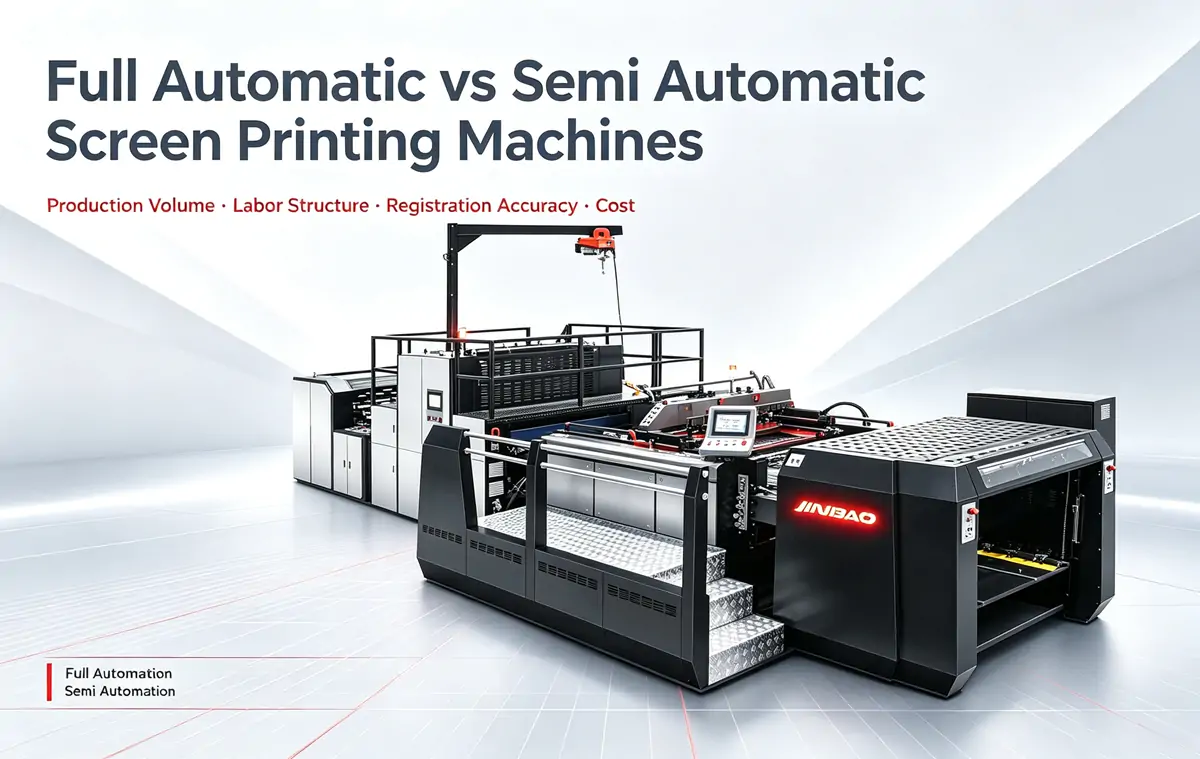
The choice between a full automatic screen printing machine and a semi automatic one comes down to one question: does your production volume and labor structure justify the higher capital investment of full automation? A full automatic machine handles feeding, registration, printing, take-off, and stacking without operator intervention. A semi automatic machine automates the printing stroke but requires an operator to place and align each sheet manually. Neither is universally better—the right choice depends on your typical job size, substrate mix, labor costs, and available floor space.
This guide breaks down the practical differences between the two machine types so you can evaluate which configuration matches your production reality.
The Core Difference: Where Automation Stops
The term "automatic" is used loosely in the screen printing industry. To make a meaningful comparison, it helps to define exactly which steps are automated in each machine type. For a broader overview of automatic screen printing technology, see the automatic screen printing machine guide.
| Production Step | Full Automatic | Semi Automatic |
|---|---|---|
| Sheet feeding | Automatic feeder picks from pile | Operator places each sheet manually |
| Registration | Automatic front lay and side guide alignment | Operator aligns sheet against mechanical stops |
| Printing stroke | Automatic squeegee and flood bar cycle | Automatic or foot-pedal initiated |
| Take-off | Automatic gripper or suction removal | Operator removes printed sheet |
| Stacking | Automatic stacker at delivery end | Manual stacking or simple collection tray |
The key distinction is that a full automatic machine maintains a continuous production cycle—sheets move from pile to printed stack without human intervention. A semi automatic machine breaks the cycle at feeding and take-off, which introduces operator-dependent variation and limits throughput.
Production Speed and Output Consistency
Production speed is the most visible difference between the two machine types, but the relationship is not linear. A semi automatic machine can achieve surprisingly high cycle rates on simple single-color jobs, particularly with an experienced operator. However, that speed cannot be sustained over a full shift—operator fatigue, break times, and the need for constant attention gradually reduce output.
A full automatic machine runs at a consistent rate throughout the shift. The feeder, registration system, and take-off mechanism do not tire. Once the machine is set up and running, output remains steady hour after hour.
Where full automation gains the most:
- Multi-color jobs requiring repeated passes through the press
- Long runs of 5,000 sheets or more where setup time is amortized
- Jobs where registration accuracy must be maintained across thousands of sheets
- Production environments with multiple shifts or limited skilled labor
Where semi automation remains competitive:
- Short runs under 1,000 sheets where setup time dominates total production time
- Jobs with frequent substrate or design changes
- Prototype and sample production
- Shops where skilled operators are available and labor costs are manageable
Labor Requirements and Skill Dependency
Labor is often the deciding factor in the full automatic vs semi automatic decision. The two machine types require different types and amounts of labor.
A semi automatic machine requires an operator to be present and actively engaged for every sheet. The operator's speed, attention, and consistency directly determine output quality. A skilled operator on a semi automatic press can produce excellent work, but the process is inherently dependent on human performance.
A full automatic machine shifts the operator's role from active production to setup and monitoring. One operator can supervise a full automatic line while performing other tasks—checking ink viscosity, preparing the next job, or managing screen inventory. The machine does not require constant attention once running correctly.
For shops in regions with high labor costs or difficulty finding skilled operators, the labor savings of full automation can justify the higher initial investment within a few years of operation. For shops with access to experienced operators and lower labor costs, the semi automatic machine may deliver acceptable output at a significantly lower capital cost.
Registration Accuracy and Print Quality
Registration accuracy is critical for multi-color work, and here the full automatic machine has a structural advantage. In a semi automatic press, the operator aligns each sheet manually against mechanical stops. Small variations in how the sheet is placed—even a fraction of a millimeter—accumulate across the run and can cause visible misregistration in multi-color jobs.
A full automatic machine uses mechanical or sensor-based registration systems to position each sheet. The alignment is consistent from sheet to sheet, eliminating operator-dependent variation. Modern automatic machines use self-setting CNC sensor registration systems that detect substrate position and adjust automatically, maintaining registration accuracy even when sheet dimensions vary slightly within a pile.
For single-color work or applications where registration tolerances are wide, the semi automatic machine can produce acceptable results. For multi-color packaging, label, or electronic printing, the automatic machine's registration consistency is a significant quality advantage.
Substrate Handling and Job Flexibility
Semi automatic machines are often praised for their flexibility—an operator can handle almost any sheet size or thickness by adjusting the placement manually. This is true to a point, but the flexibility comes with trade-offs.
Full automatic machines require setup time for each new job: the feeder must be adjusted for sheet size and weight, the registration system calibrated, and the take-off mechanism positioned. This setup can take 30 minutes to an hour or more depending on the machine and the operator's experience. For very short runs, this setup time may exceed the actual production time.
However, once set up, the automatic machine handles the full range of substrates within its specifications—from thin decal paper to heavy paperboard—with consistent results. The operator does not need to adjust feeding or registration during the run.
Semi automatic machines are better suited for jobs where the substrate or design changes frequently. The operator can switch from one job to the next with minimal setup, making the semi automatic press a practical choice for sample production, proofing, or very short runs.
Capital Investment and Operating Cost
The initial cost of a full automatic screen printing machine is significantly higher than a semi automatic machine of comparable print area. The additional cost reflects the feeder, registration system, take-off mechanism, and stacker—components that are absent or simplified on a semi automatic press.
Operating costs also differ. A full automatic machine consumes more power due to the additional motors and control systems. It requires compressed air for pneumatic components. It requires more floor space. And it requires more thorough maintenance—more moving parts mean more lubrication points, more wear items, and more frequent inspection.
However, the labor cost per printed sheet is significantly lower on a full automatic machine. For high-volume production, the labor savings quickly offset the higher initial investment. The break-even point depends on local labor costs and production volume—typically falling in the range of 2,000 to 3,000 sheets per shift for many applications.
Decision Framework: Which Machine Fits Your Production?
Use the following framework to evaluate which machine type matches your production requirements.
| Production Factor | Favors Full Automatic | Favors Semi Automatic |
|---|---|---|
| Typical run length | 5,000+ sheets per job | Under 1,000 sheets per job |
| Number of colors | Multi-color, tight registration | Single color or loose registration |
| Labor availability | Limited or high-cost labor | Skilled operators available |
| Shift pattern | Multiple shifts, continuous production | Single shift, flexible hours |
| Job changeover frequency | Infrequent changeovers | Frequent job changes |
| Substrate consistency | Consistent substrate within runs | Varied substrates and thicknesses |
| Capital budget | Higher initial investment available | Limited capital budget |
The 3/4 Automatic Option
For shops that need more automation than a semi automatic machine but are not ready for the full investment of a complete automatic line, a 3/4 automatic press offers a middle path. These machines automate the printing stroke and take-off but require manual feeding. The operator places each sheet on the registration table, and the machine handles the rest.
3/4 automatic presses are a popular upgrade for shops transitioning from manual or semi automatic production. They reduce operator fatigue, improve registration consistency compared to fully manual feeding, and cost significantly less than a full automatic machine. The manual feeding step remains a bottleneck, but for moderate production volumes, the trade-off may be acceptable.
Frequently Asked Questions
Can a semi automatic machine produce the same print quality as a full automatic machine?
Yes, a skilled operator on a well-maintained semi automatic machine can produce excellent print quality. The difference is consistency—a full automatic machine maintains the same registration and ink deposit from the first sheet to the last, while a semi automatic machine's output depends on the operator's attention and fatigue level.
How long does it take to set up a full automatic machine for a new job?
Setup time varies by machine and job complexity, but typically ranges from 30 minutes to over an hour. This includes adjusting the feeder for sheet size and weight, calibrating the registration system, positioning the take-off mechanism, and running test sheets to verify registration and ink deposit.
What is the break-even point between full automatic and semi automatic?
The break-even point depends on local labor costs, production volume, and job complexity. As a general guideline, the labor savings of full automation typically justify the higher investment at production volumes above 2,000 to 3,000 sheets per shift for multi-color work.
Can a semi automatic machine be upgraded to full automatic later?
In most cases, no. The mechanical structures of semi automatic and full automatic machines are fundamentally different. Adding an automatic feeder, registration system, and stacker to a semi automatic press is not practical or cost-effective. Shops planning to grow into full automation should consider purchasing a full automatic machine from the start, or choose a 3/4 automatic press as an intermediate step.
Next Steps
The decision between full automatic and semi automatic screen printing machines is ultimately a business decision, not just a technical one. Consider your production volume, labor costs, quality requirements, and growth plans. If your production volume is growing and labor costs are a concern, full automation may deliver better long-term value. If your production is varied and runs are short, the flexibility of a semi automatic machine may be more practical.
If you have specific production requirements, discuss your material and production needs directly with the supplier to confirm the appropriate configuration.