English
 中文
 Pусский
 Español
 Français
 عربي

Industrial Screen Printing: What It Is, How It Works, and Where It Still Wins
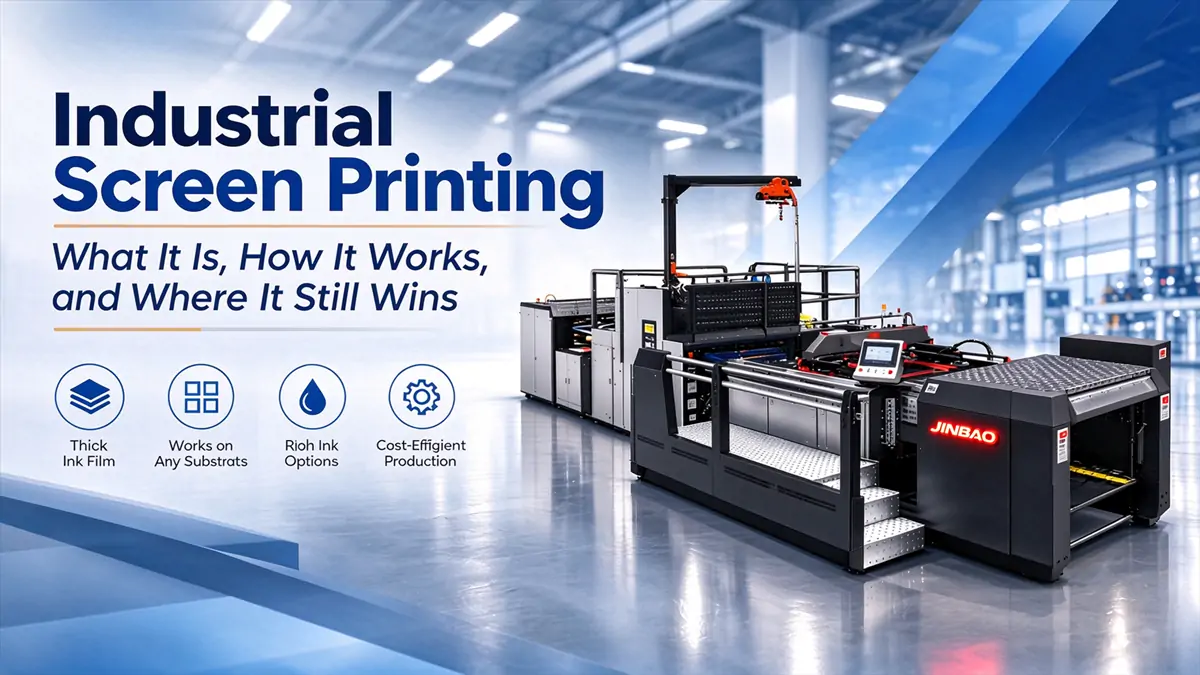
Industrial screen printing is a stencil process that forces ink through a tensioned mesh to build an ink film far thicker than offset, flexo or inkjet can deliver. That thickness, combined with near-total substrate freedom and an open ink chemistry, is why the method still holds up for packaging, glass, ceramics, electronics and appliance work.
This guide explains the mechanism, the machine classes and the variables that decide quality, then sets out where the method still beats the alternatives and where it does not.
1. What the Process Physically Does
Five elements do the work: the mesh screen, the stencil (emulsion or capillary film), the squeegee, the ink, and the substrate handling system. Nothing else is essential.
One cycle takes under a second. The flood stroke fills the open mesh with ink while the screen is still lifted off the sheet. The print stroke then drives the squeegee across the stencil, and the mesh is pushed into contact with the substrate along a narrow line just ahead of the blade. Behind that line, the mesh snaps back, and the ink that was in the openings stays on the sheet as a shaped deposit.
Two consequences follow directly. First, the deposit is defined by mesh open area and stencil thickness, not by pressure alone — which is why screen printing is a deposition process as much as an image-transfer process. Second, the ink never touches a plate, blanket or roller, so the same principle works on paper, board, PVC, glass, aluminium, ceramic and laminated film without changing the mechanism.
What separates an industrial press from a garment shop machine is everything around that cycle: sheet feeding and registration to ±0.1–0.5 mm, multi-colour stations on a common frame, inline curing, and the mechanical rigidity to hold those tolerances across a shift. The mechanism itself is straightforward; what actually separates buyers is what the thick film makes possible, which is where the rest of this guide spends its time.
2. Why the Method Survives: Four Structural Advantages
Ink film thickness. The table below is the single most useful comparison in this article, because most downstream decisions follow from it.
| Method | Typical dry film thickness | Practical consequence |
|---|---|---|
| Offset litho | 1–2 µm | Excellent detail on paper; opacity must come from the paper or a base white |
| Flexo | 2–6 µm | Good on corrugated and film; limited opacity on dark stock |
| Digital inkjet | 2–10 µm | Variable data, no tooling; thin film, weak on transparent and metallic |
| Pad printing | 5–15 µm | Curved small parts; small image area |
| Screen printing | 10–100 µm (special effects beyond) | Opaque white on black, tactile varnish, Braille, conductive tracks, fired enamel |
A thick film is not a defect — it is the product in many applications. It gives hiding power on dark or transparent substrates, abrasion resistance, the raised texture of tactile varnish, and the cross-sectional area that makes a printed conductor actually conduct.
Substrate freedom. Sheet size is the main limit, not material. The same process runs on 80 gsm transfer paper and on 3 mm aluminium, on 0.2 mm PET and on a fired ceramic decal. Curved and cylindrical parts are handled by rotary screens or by fixtures on semi-automatic machines.
Open ink chemistry. Solvent, water-based, UV-curable, plastisol, ceramic enamel, silver and carbon conductive paste, dielectric, etch resist, solder mask — all are printable because the ink only has to flow through a mesh and then stay where it was placed. No other conventional process offers that range, which is exactly why functional and electronics printing still depends on it.
Tooling economics. One colour equals one screen. A screen costs a fraction of a gravure cylinder or a full flexo plate set, can be reclaimed and re-coated, and can be remade in hours. That is why screen printing tolerates mid-length runs and frequent design changes far better than rotogravure, while still beating digital on cost per square metre once coverage and colour count rise.
3. Where It Is Actually Used
The useful way to read this list is not by industry, but by what the film is doing in each case.
| Application | Typical substrate | Why screen printing is chosen |
|---|---|---|
| Folding cartons, luxury packaging | Board 250–1,000 gsm | Spot UV, cold foil adhesive, metallic and tactile effects in one pass |
| Labels and transfer | Paper, film, transfer paper | Opaque white, high-density colour, durable film |
| Glass and ceramic decals | Glass, ceramic, enamel | Fired enamel needs a thick, metal-oxide-loaded film |
| Membrane switches, printed electronics | PET, PC, ITO film | Silver and carbon tracks, dielectric layers, precise deposit weight |
| PCB etch resist, solder paste | Copper clad laminate | Chemical resistance and sufficient film build |
| Appliance and automotive panels | PC, PMMA, painted metal | Weathering resistance, fine graphics on textured surfaces |
| Medical diagnostics | Nitrocellulose, PET | Controlled reagent deposition |
| Textiles and heat transfer | Fabric, transfer film | High-opacity plastisol and elastic films |
Note the pattern: screen printing dominates wherever the amount of material matters as much as the image. Most of these jobs run on full automatic screen printing machines; semi-automatic and manual presses are for sampling, very short runs and moulded parts.
4. The Machine Classes You Will Meet
Each class has its own logic; the useful question here is which class a given job constraint points to.
| Class | Handling | Character | Typical work |
|---|---|---|---|
| Semi-automatic flatbed | Manual or semi-manual feed | Low capital, quick changeover, operator-dependent registration | Sampling, short runs, curved parts on fixtures |
| Full automatic stop-cylinder | Automatic sheet feeder, cylinder holds the sheet stationary under the screen | Registration to ±0.1 mm, multi-colour, high sustained output | Packaging, transfer, spot UV, decals |
| Rotary / stop-rotary | Cylindrical screen rotates with the substrate | High linear speed, continuous web | Labels, decorative film, textiles |
| Inline finishing line | Screen stations plus UV, cold foil, window patching | One pass, one registration chain | Folding cartons with combined effects |
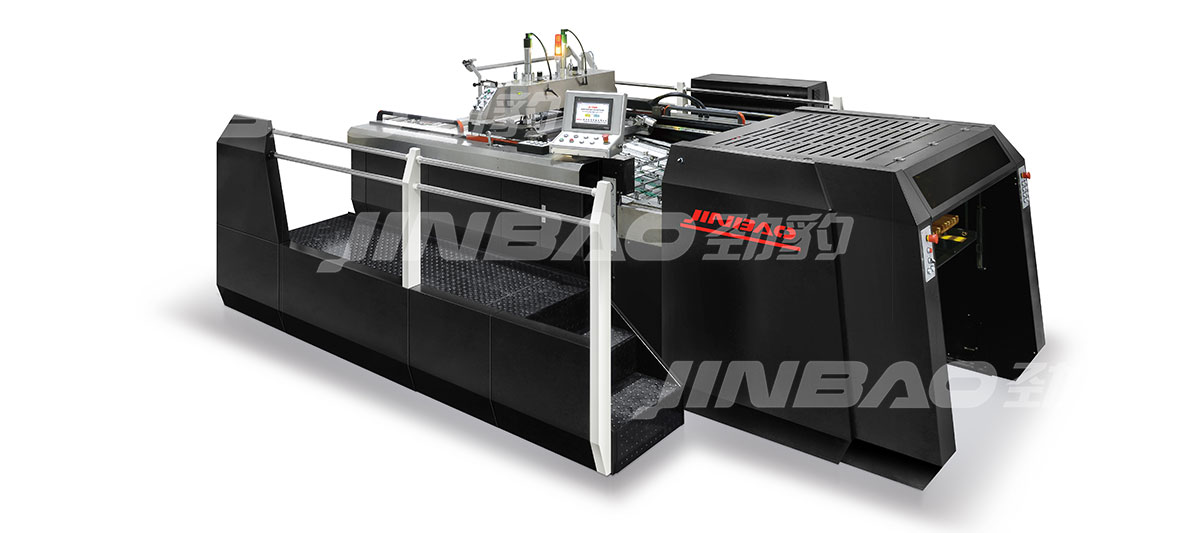
The stop-cylinder and rotary rows above differ mainly in how the sheet is held during the print stroke, which is a mechanical question rather than a printing one. Our guide to the cylinder screen printing machine covers that mechanism in detail, including the stop and swing variants and the specification items buyers compare.
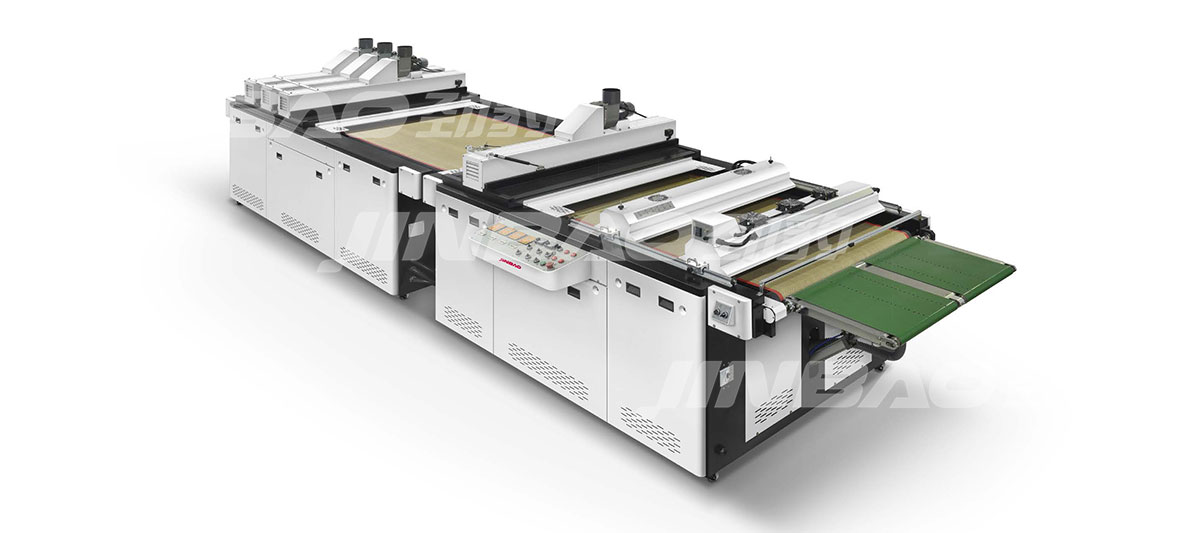
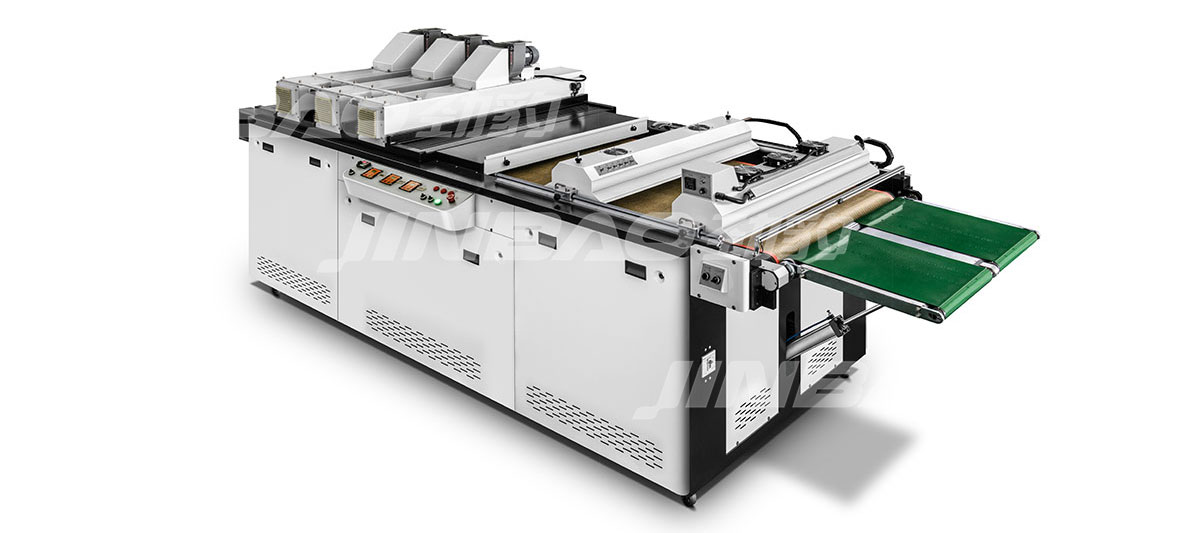
The format range matters more than the model name. A press that tops out at a small sheet cannot be pushed to large-format packaging work no matter how it is tuned, and a large-format press running small jobs wastes cycle time on travel distance. Zhejiang Jinbao Machinery builds this range from compact stop-cylinder models such as the JB-54C through the JB-106C and JB-145C presses, plus the JB-720AQ line for electrical and electronic production — each aimed at a different position on that format-and-volume map.
5. The Variables That Actually Decide Quality
Registration failures and pinholes rarely come from the press alone. They come from the six settings below drifting out of relationship with each other. On a cylinder press, most of them are held by the machine; on a flatbed or semi-automatic press, they are held by the operator — which is the real difference between the two in daily use.
| Variable | What it controls | Typical setting | Symptom when wrong |
|---|---|---|---|
| Mesh count | Ink volume and detail resolution | 90–180 threads/cm for graphics; coarser for heavy deposits | Too fine: starvation and moiré. Too coarse: ragged edges |
| Mesh tension | Registration repeatability, snap-off consistency | 15–25 N/cm, uniform across the frame | Low tension: image shift, blurred edges, stencil fatigue |
| Stencil thickness | Deposit height | 10–25 µm standard; 50–150 µm for tactile and functional | Thin: weak opacity. Thick: poor resolution, longer exposure |
| Squeegee hardness and angle | Ink shear and transfer efficiency | 60–80 Shore A, 60–75° | Too hard or steep: starving. Too soft or shallow: flooding |
| Off-contact distance | When and where the mesh releases | 1–3 mm, scaled to format | Too little: smearing and ghosting. Too much: distortion and low deposit |
| Ink viscosity | Flow through the mesh, levelling | Adjusted to job, checked with a flow cup | Too high: pinholes and missed areas. Too low: edge bleed |
Cure sits outside that table but belongs to it. An under-cured UV film feels dry and fails adhesion two days later; an over-cured film embrittles and cracks on folding. Dose and belt speed have to be verified per ink, per colour and per substrate — not copied from the last job.
6. Ink Systems and How They Set the Line Configuration
| Substrate | Ink system | Cure | Note |
|---|---|---|---|
| Paper, board | UV, water-based, solvent | UV or thermal | UV allows inline spot UV, cold foil and immediate converting |
| Plastic film (PET, PVC, PC) | UV, solvent | UV with low-temperature lamps | Heat-sensitive film needs LED UV or chilled drum |
| Glass, ceramic | Enamel, organic-free | Firing at 560–620 °C | Deposit thickness is a functional requirement, not a style choice |
| Metal | Epoxy, UV, solvent | Thermal or UV | Adhesion depends on surface treatment as much as ink |
| Electronics | Silver, carbon, dielectric, resist | Thermal or UV | Deposit weight and edge definition determine electrical yield |
This is where line architecture is decided. A packaging line that must produce spot UV and cold foil in the same pass needs UV stations sized for the press speed, not for the ink alone. A glass decal line needs firing capacity and dimensional stability, not curing. Both configurations exist as printing and finishing lines rather than as isolated presses, and the combination is usually what determines real output rather than the press rating on its own.
7. Where Screen Printing Loses — An Honest Comparison
| Method | Strength | Limitation | Best fit |
|---|---|---|---|
| Offset | Fine detail, very low cost per sheet at high volume | Thin film, poor opacity on transparent or dark stock | Long-run publication and commercial print |
| Flexo | High speed on web, integrated into corrugated lines | Limited deposit, plate cost per colour | Corrugated, flexible packaging |
| Digital inkjet | No tooling, variable data, fast turnaround | Thin film, high cost per square metre at volume, limited opaque white | Short runs, personalisation, proofs |
| Pad printing | Curved and 3D small parts | Small image area, low output | Promotional and technical small parts |
| Rotogravure | Excellent consistency at very long runs | Cylinder cost and lead time | High-volume flexible packaging |
| Screen printing | Thick film, any substrate, functional inks, low tooling | Speed lower than offset; one screen per colour; skilled setup | Effects, opacity, glass, electronics, industrial graphics |
The practical rule: if the job needs material rather than merely an image, screen printing is usually the incumbent. If the job needs resolution and volume at low cost, offset or flexo wins. If the job needs one copy of many versions, digital wins.
8. Cost Behaviour Without Invented Numbers
- Makeready is fixed per colour. Screen making, mounting, registration and ink adjustment happen whether you run 500 sheets or 50,000. Cost per sheet therefore falls steeply, then flattens.
- Screen cost and reclaim repeat every design change. Frequent SKUs with small volumes erode the advantage over digital.
- Ink consumption follows deposit thickness. A 60 µm white costs several times the ink of a 15 µm graphic layer over the same area; quoting by area alone hides this.
- Cure energy is a per-hour cost, not a per-job cost. Undersized UV capacity forces slower belt speed, which converts directly into lost output.
- Rejects concentrate at startup. The first 20–50 sheets carry most defects; a documented first-off approval routine cuts that waste more than any mechanical upgrade.
- Skill is a line item. Registration and ink rheology judgement take months to learn. Two operators who understand mesh tension and squeegee geometry will outproduce four who do not.
9. Quality Control Checklist
| Check | Method | Basis for acceptance |
|---|---|---|
| Mesh tension | Tensiometer at four quadrants | Within ±1 N/cm of specified value, uniform |
| Stencil thickness | Coating gauge before exposure | Matches job specification for deposit |
| Registration | First-off sheet plus hourly pulls | Within agreed tolerance, all colours |
| Ink viscosity | Flow cup before each run | Within supplier window for the job |
| Ink deposit weight | Weigh a known area of dried print | Within job tolerance |
| Adhesion | Cross-hatch plus tape pull | No removal beyond agreed level |
| Cure | Solvent rub (MEK or acetone), double rubs | No film breakdown or colour transfer |
| Pinholes and dirt | Inspection under raking light | Zero in critical image areas |
| Colour match | Spectrophotometer or approved sample | ΔE within agreed limit |
| Folding and abrasion | Fold, crease or rub test on finished part | No cracking at the fold line |
10. What to Bring to a Machine Specification Discussion
A supplier cannot size a line from a product photo. Six data points decide most of it: substrate type and caliper range, maximum and typical sheet size, number of colours including special effects, sustained output per shift actually required, cure chemistry, and available floor space together with power and compressed air capacity.
Two further items are routinely forgotten and cause most commissioning delays: existing pre-press capability for screen making, and the plan for spare screens and wear parts. A press that arrives without either will run below its rated speed for months. Spare parts, installation and commissioning support and warranty terms should be settled before the purchase order, not after the first breakdown.
11. FAQ
How thick an ink film can screen printing produce?
Standard graphic work runs 10–25 µm dry. Tactile varnish, Braille and fired enamel go considerably higher, and functional inks are specified by deposit weight rather than thickness because conductivity and resistance depend on cross-section.
Can screen printing print on curved or three-dimensional parts?
Yes, within limits. Rotary screens handle continuous cylindrical work, and semi-automatic presses with fixtures print on moulded and tapered parts. Very deep draws or sharp curvature changes usually move the job to pad printing or heat transfer.
Is screen printing economical for short runs?
Only when the effect cannot be produced otherwise. One screen per colour plus makeready makes very short runs expensive per unit; digital usually wins below a few hundred pieces, and the crossover point moves with colour count and coverage.
What causes pinholes in a solid screen-printed area?
Usually dirty mesh, dried-in ink, insufficient emulsion over mesh, or viscosity that is too high for the mesh count. Persistent pinholes in the same location point to a stencil defect; random pinholes point to ink or cleaning practice.
How do you confirm the ink is fully cured?
A solvent rub is the practical field test; cross-hatch adhesion after 24 hours confirms the same thing more formally. Visual dryness is not evidence of cure, and under-cured UV ink often fails only after folding or stacking.
For folding cartons, is screen printing better than flexo or digital?
It is not a replacement — it is usually an addition. Screen printing adds opaque white, spot UV, tactile varnish, cold foil adhesive and metallic density that the base print method cannot achieve, and inline configurations run those effects in one pass with the carton.
12. Conclusion
The decision is not whether screen printing is modern — it is whether the job needs a film rather than an image. If opacity on dark or transparent stock, tactile or functional deposit, glass or metal, or conductive paste is the requirement, screen printing remains the most direct route, and the variables that decide whether it works are mesh tension, stencil thickness, squeegee geometry and cure verification, in that order.
The common mistakes are predictable: specifying a press by speed rating instead of by substrate and format, under-sizing cure capacity, treating screen making as an afterthought, and accepting a first-off sheet without measuring deposit or adhesion. Any one of those will make a good machine look unreliable.
When substrate, effect and volume sit near a boundary — very short runs, very fine detail, very tight colour control — the fastest way to settle it is to send us your substrate and run length rather than compare catalogues.