English
 中文
中文 Pусский
 Español
 Français
 عربي
عربي
What Affects the Print Speed of a Full Automatic Screen Printing Machine?
When comparing full automatic screen printing machines, the first question buyers ask is usually about speed—how many sheets per hour can it produce? The answer is never a single number. Even machines in the same series can deliver very different real-world output depending on what's being printed, how it's handled, and how the line is configured. A full automatic screen printing machine rated for 4,000 sheets per hour on paper may run at half that speed on thick board or when applying heavy UV varnish. Understanding the variables that affect print speed helps buyers set realistic production expectations and configure the right machine for their application.
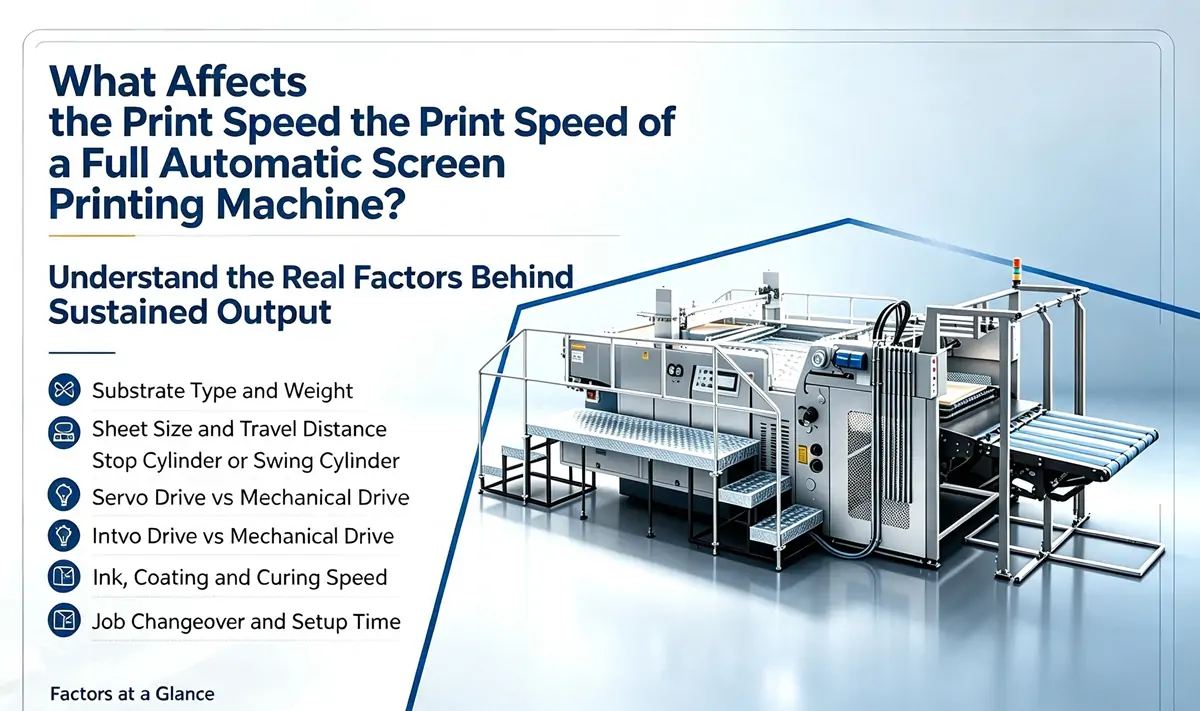
1. Substrate Type, Size, and Weight
The material being printed is the single biggest speed variable. The JINBAO product range covers applications from decal paper and stickers to packaging boxes, ceramic decals, and electronic components—each with very different handling requirements.
Lighter substrates such as decal paper and thin films can be fed and transported faster, allowing the machine to run closer to its maximum cycle rate. Heavier materials—cardboard, thick packaging stock, or rigid substrates—require slower feeding, gentler handling, and longer transport time between stations. Sheet size matters as well: a machine printing a 720mm × 520mm sheet has a longer travel distance per cycle than one running a smaller format, which directly affects the maximum cycles per minute.
The JINBAO product page lists models ranging from the JB-54C (smaller format) to the JB-145C (larger format). The larger the maximum sheet size, the more the physical travel distance can influence cycle time.
2. Stop Cylinder vs Swing Cylinder Design
The printing mechanism itself is a defining speed factor. JINBAO's full automatic range divides into two structural types: stop cylinder and swing cylinder screen printing machines.
• Stop cylinder machines pause the substrate under the screen while the squeegee passes, then advance the sheet. This design typically delivers higher registration accuracy and is suited for multi-color work and fine detail. The stop-and-go motion means the cycle time includes a dwell period.
• Swing cylinder machines use a continuous rotary motion, allowing faster throughput. They are commonly chosen for high-volume single-color or less registration-critical work, such as decal printing.
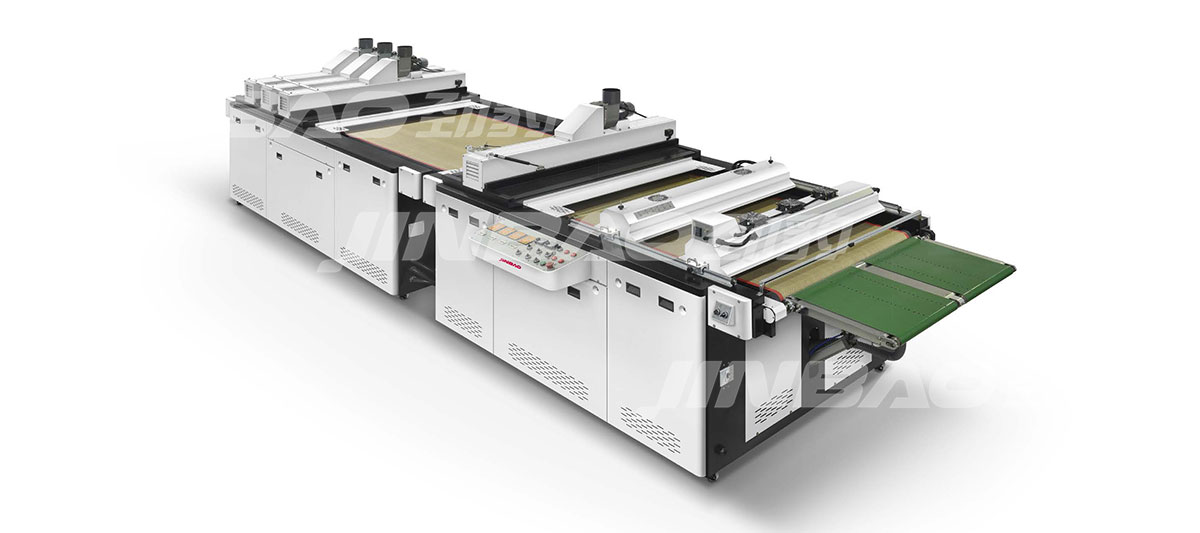
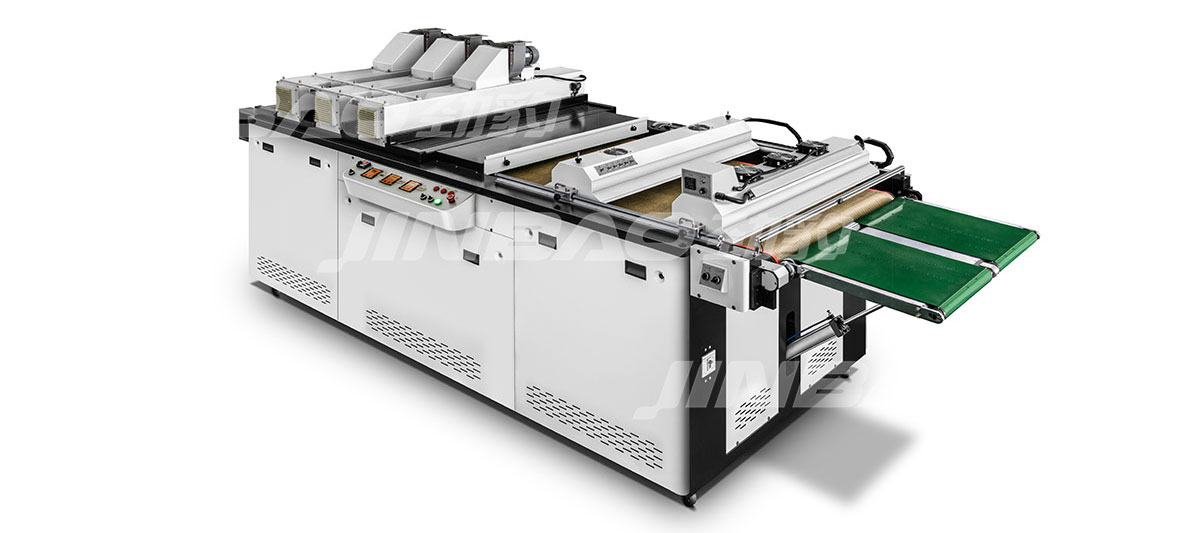
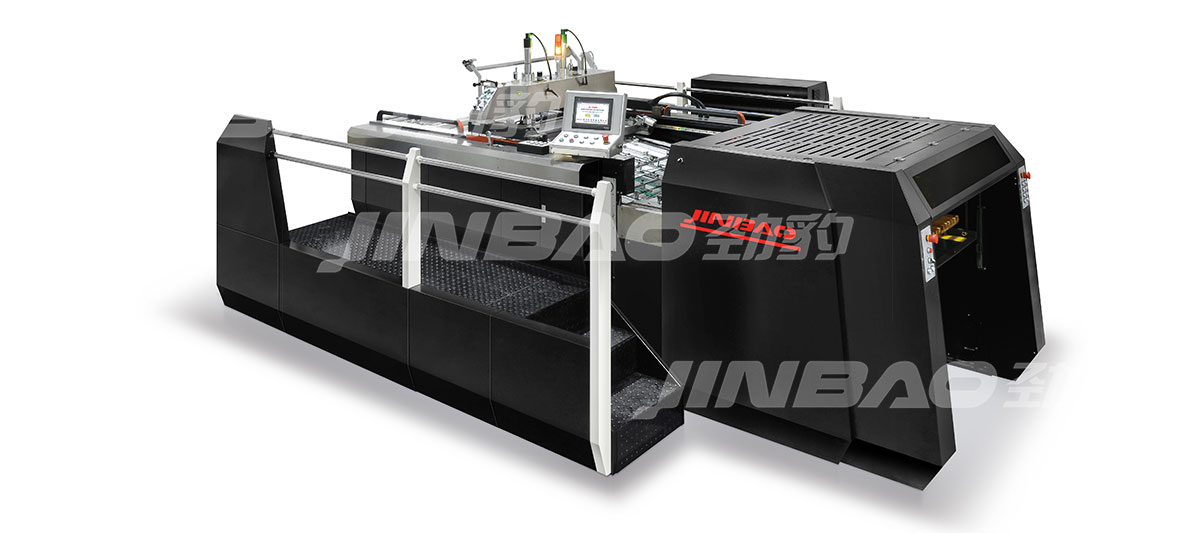
The choice between the two directly affects both achievable speed and print quality requirements. A swing cylinder machine may run faster in sheets per hour, but if the job requires tight multi-color registration, a stop cylinder machine's dwell time is necessary—and the "slower" cycle may still deliver better net productivity by reducing rejects. For a closer look at the differences in design and applications, you can review the full range of fully automatic screen printing machines.
3. Servo Drive vs Mechanical Drive
The drive system determines how quickly and precisely the machine can cycle, accelerate, and decelerate. The JINBAO product range includes both servo-driven models (marked as "Servo Version") and mechanical versions.
Servo-driven machines use electronically controlled motors that allow faster acceleration, smoother motion profiles, and programmable speed settings for different parts of the cycle. This means they can run at higher speeds while maintaining registration accuracy, and they can be fine-tuned for specific substrates.
Mechanical versions rely on cam-driven mechanical linkages. While robust and proven, they typically have a fixed motion profile that cannot be optimized per job. The maximum cycle speed is mechanically limited and less flexible across different materials.
For high-speed production of standard jobs, the servo advantage becomes most apparent in the non-printing portions of the cycle—faster sheet transport, quicker screen frame return, and reduced dwell time between sheets.
4. Ink Type, Deposit Thickness, and UV Curing
What's being printed matters as much as what it's being printed on. Heavier ink deposits—such as spot UV varnish, metallic inks, or thick ceramic pastes—require slower squeegee travel to achieve even coverage. The screen mesh count also plays a role: finer meshes for detailed work deposit less ink but may require more precise, slower strokes.
If UV curing is integrated inline, the curing unit speed must match or exceed the printer speed. JINBAO's product line includes dedicated UV curing machines designed to work with both full automatic and semi-automatic presses. The curing time depends on the ink chemistry, deposit thickness, and lamp power. If the UV unit cannot cure the ink fast enough, it becomes the bottleneck—the printer must slow down to match the curing capacity.
For water-based or solvent inks used with hot air drying, the dryer length and temperature profile set the maximum line speed. A longer dryer may allow faster throughput, but it also requires more floor space.
5. Job Changeover and Setup Time
Average speed over a full shift is not the same as the machine's maximum cycle rate. Frequent job changes—switching between different substrates, inks, or screen frames—eat into productive running time.
Setup tasks that affect overall productivity include:
• Screen frame change and registration adjustment
• Squeegee and flood bar setting for different ink types
• Feeder adjustment for different sheet sizes and weights
• UV lamp warm-up and power setting changes
A machine that can complete changeover in 15 minutes versus one that takes 30 minutes gains an extra hour of production over four job changes in a day. Servo-driven machines with digital recipe storage can shorten this time by recalling settings electronically rather than requiring manual mechanical adjustments.
Factors at a Glance
| Factor | Impact on Print Speed |
|---|---|
| Substrate type and weight | Lighter, thinner materials allow faster feeding and transport |
| Sheet size | Larger sheets mean longer travel distance per cycle |
| Cylinder type | Swing cylinder offers higher continuous speed; stop cylinder provides better registration |
| Drive system | Servo allows faster acceleration and programmable motion profiles |
| Ink and coating type | Heavy deposits and UV varnish require slower squeegee travel |
| Curing/drying speed | Inline UV or dryer capacity sets the maximum line speed |
| Changeover time | Quicker setup preserves more running time per shift |
All machine type references based on JINBAO product categories. Actual performance depends on specific substrate, ink, job configuration, and operating conditions.
Frequently Asked Questions
Q: Which is faster—stop cylinder or swing cylinder screen printing?
A: Swing cylinder machines typically run at higher continuous speeds because they use a rotary motion without the dwell period of stop cylinder designs. However, stop cylinder machines provide better registration accuracy for multi-color work. The right choice depends on whether speed or precision is the priority for your application.
Q: How much faster is a servo-driven machine compared to a mechanical version?
A: Servo-driven machines can accelerate, decelerate, and change direction faster than mechanical cam-driven systems. The speed difference is most noticeable in the non-printing portions of the cycle—sheet transport and screen frame return. The actual improvement depends on the specific job and substrate.
Q: Can I run all substrates at the same speed on one machine?
A: No. The same machine running lightweight decal paper will typically cycle faster than when running thick packaging board. The feeder, transport, and delivery systems all need to be adjusted for different materials, and heavier stock requires slower handling to avoid misregistration or damage.
Q: Does UV curing always slow down the printing line?
A: If the UV curing unit is not sized to match the printer's maximum speed, it becomes the bottleneck. The key is matching lamp power, wavelength, and curing tunnel length to the ink chemistry and deposit thickness so the curing unit can keep pace with the printer.
Q: What's the most overlooked factor that reduces real-world printing speed?
A: Job changeover and setup time. A machine that runs 4,000 sheets per hour but takes 45 minutes to change over between jobs may produce less in a shift than a slightly slower machine that changes over in 15 minutes. Total shift output, not maximum cycle rate, is what drives revenue.
Conclusion
The print speed of a full automatic screen printing machine is not a single specification—it's the net result of substrate characteristics, cylinder design, drive system, ink and curing requirements, and how efficiently the machine is set up and changed over. The most useful metric is not the maximum rated speed, but the sustained output per shift for your specific mix of jobs and materials.If you'd like to discuss your specific application and expected throughput, contact JINBAO to discuss your printing requirements.