English
 中文
中文 Pусский
 Español
 Français
 عربي
عربي
How to Reduce Foil Waste on Your Cold Foil Stamping Machine
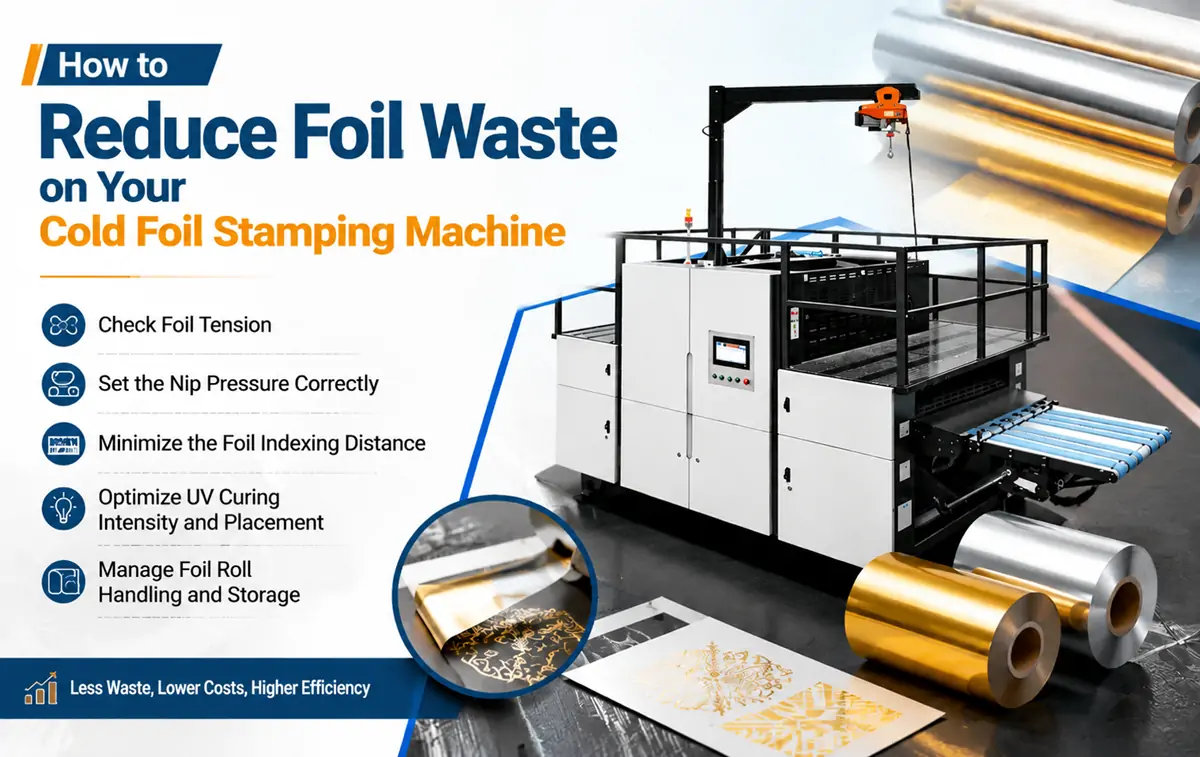
Cold foil is one of the most expensive consumables on a sheet-fed finishing line. When a Cold Foil Machine is not properly adjusted, the waste accumulates quietly—a few extra millimeters of foil pulled per sheet across thousands of impressions adds up to kilograms of discarded material. The causes are rarely mechanical failure. More often, the machine settings that control foil tension, indexing distance, nip pressure, and UV application have drifted from their optimal values. Adjusting these parameters systematically recovers foil that would otherwise end up in the scrap bin.
Check Foil Tension First
Foil tension is the most common root cause of both waste and transfer defects. When tension is too low, the foil web sags between the unwind and nip rollers. The slack creates wrinkles that prevent even contact with the substrate, producing patchy transfer. Operators often compensate by increasing the foil advance distance, which wastes material without fixing the wrinkle problem.
When tension is too high, the foil stretches as it passes through the nip. Stretched foil transfers unevenly because the metallized layer separates from the carrier film inconsistently. The foil may also break during the indexing cycle, forcing a line stop while the web is rethreaded. A broken web mid-run can waste several meters of foil in a single incident.
Correct tension depends on the foil width and substrate type, but a starting point for many cold foil units is a tension setting that allows the foil to lay flat against the substrate without visible slack or stretching. Test by running the foil advance cycle without printing and observing the web behavior at the unwind and rewind stations. The foil should track straight with no lateral movement, and the rewind roll should build evenly without telescoping.
Set the Nip Pressure Correctly
The nip roller presses the foil against the substrate at the transfer point, where UV-curable adhesive bonds the metallized layer. Excessive nip pressure compresses the foil against the substrate and adhesive, forcing adhesive beyond the image area. When the foil separates from the substrate after UV curing, the metallized layer transfers across a wider area than intended. This edge bleed wastes foil not just on the current sheet but across the entire web width for that section.
Insufficient nip pressure leaves the foil and adhesive in incomplete contact. The transfer becomes partial, and operators often respond by slowing the machine or increasing the foil advance distance—both of which increase waste per finished sheet.
The correct nip pressure is the minimum required to achieve full transfer across the entire image area. Test by running a sample sheet and inspecting the transferred foil under magnification. Full transfer with clean, sharp edges indicates sufficient pressure. If edge definition is sharp but a ghost image appears outside the transfer area, reduce pressure incrementally until the ghosting disappears.
Nip pressure should be checked at the start of each shift and after any change in substrate caliper. A substrate change from 0.3 mm board to 0.5 mm board changes the effective nip gap, requiring a pressure adjustment to maintain the same transfer quality.
Minimize the Foil Indexing Distance
The foil indexing distance—how far the foil advances between sheets—directly determines foil consumption per sheet. Every millimeter of unnecessary advance translates to wasted foil across the entire run. The goal is to set the indexing distance so that the foil advances just enough to present a fresh section for the next sheet, with minimal unused foil between transfer areas.
The minimum indexing distance is determined by the image length plus a small gap between successive transfer areas. This gap prevents the trailing edge of one transfer from overlapping with the leading edge of the next. A gap of 3 to 5 mm is typically sufficient, though the exact requirement depends on the foil type and the machine's indexing accuracy.
If the machine uses a foil jump function—where the foil advances only when a transfer image is present and remains stationary during non-print cycles—ensure this function is enabled. Machines with foil jump capability typically consume 30% to 50% less foil on jobs where the image area occupies less than the full sheet length. The jump function is particularly effective on packaging layouts where foil accents appear on only a portion of the panel.
Verify that the indexing mechanism is calibrated. A mechanical indexer that advances 0.5 mm more than its setpoint due to wear or calibration drift wastes 0.5 mm per sheet. Across 10,000 sheets, this represents 5 meters of wasted foil. Measuring the actual advance distance with a ruler and comparing it to the setpoint identifies calibration errors that should be corrected during preventive maintenance.
Optimize UV Curing Intensity and Placement
The UV curing system hardens the adhesive at the precise moment the foil contacts it. If the UV intensity is too low, the adhesive cures incompletely and the foil transfer is partial. Operators may respond by slowing the line or increasing foil pressure—both of which increase waste. If the UV intensity is too high, it can cure the adhesive before it reaches the nip, preventing any transfer and wasting the sheet and the foil already advanced.
UV lamp output degrades over time. A lamp that delivered adequate intensity when new may fall below the required level after several hundred hours of operation. Regular measurement with a UV radiometer confirms whether the lamp output matches the adhesive manufacturer's recommended intensity for the production speed being run.
The positioning of the UV lamp relative to the nip also affects transfer efficiency. If the lamp is positioned too far upstream, the adhesive begins curing before the foil contacts the substrate. If positioned too close, the lamp may heat the foil or substrate unnecessarily. The manufacturer's specified distance between the lamp and the nip point should be maintained and verified after any maintenance that involves the lamp housing.
For operations looking to benchmark their current equipment against newer systems with integrated UV control, reviewing cold foil transfer specifications and UV integration features can clarify whether upgrading the curing system alone could reduce foil consumption on existing jobs.
Manage Foil Roll Handling and Storage
Foil waste can occur before the roll ever reaches the machine. Improper storage conditions degrade foil quality and cause transfer problems that waste both foil and production time. Cold foil should be stored in its original packaging at temperatures between 15°C and 25°C and relative humidity between 40% and 60%. Exposure to high humidity can cause the foil layers to stick together, while high temperatures can degrade the release coating that controls how the metallized layer separates from the carrier.
Foil rolls should be stored horizontally on their ends, not stacked on their sides where the weight of upper rolls can deform the cores of lower ones. A deformed core causes uneven unwinding, which produces tension fluctuations and increases the risk of web breaks. Rolls with damaged edges from handling should be inspected before mounting; a nick in the edge of the foil web creates a stress concentration that can propagate into a full-width tear during the indexing cycle.
Track and Measure Foil Usage
A systematic approach to foil waste reduction requires measurement. Without tracking consumption per job, improvements are difficult to quantify and waste tends to creep back up over time. Record the foil roll diameter or meter count at the start and end of each job, along with the number of sheets produced and the total image transfer area. Calculate the foil usage per thousand sheets and compare it across similar jobs.
This data reveals patterns: a particular substrate that consistently consumes more foil than others, a specific image layout that shows higher waste, or a shift that operates with systematically higher consumption. Each pattern points to a specific root cause that can be addressed—substrate-specific pressure settings, image-specific indexing optimization, or operator training on the shift with higher consumption.
A daily log of foil consumption, tension settings, nip pressure, and indexing distance creates a reference that operators can consult when setting up repeat jobs. Rather than starting from scratch for each production run, the operator loads the settings that produced the lowest foil consumption on the previous run of the same job and adjusts from there.
When Equipment Design Reduces Waste Automatically
Some machines incorporate design features that inherently reduce foil waste. Servo-driven indexing systems offer more precise foil advance control than mechanical indexers, reducing the safety margin needed between transfer areas. Foil jump functions, when integrated into the machine control system rather than added as an aftermarket retrofit, respond faster and handle the acceleration and deceleration of the foil web more smoothly.
For operations where foil costs represent a significant portion of consumable spending, JINBAO's cold foil transfer solutions offer detailed specifications on indexing accuracy, foil jump response time, and tension control systems—allowing a direct comparison of how equipment design choices affect ongoing foil consumption.